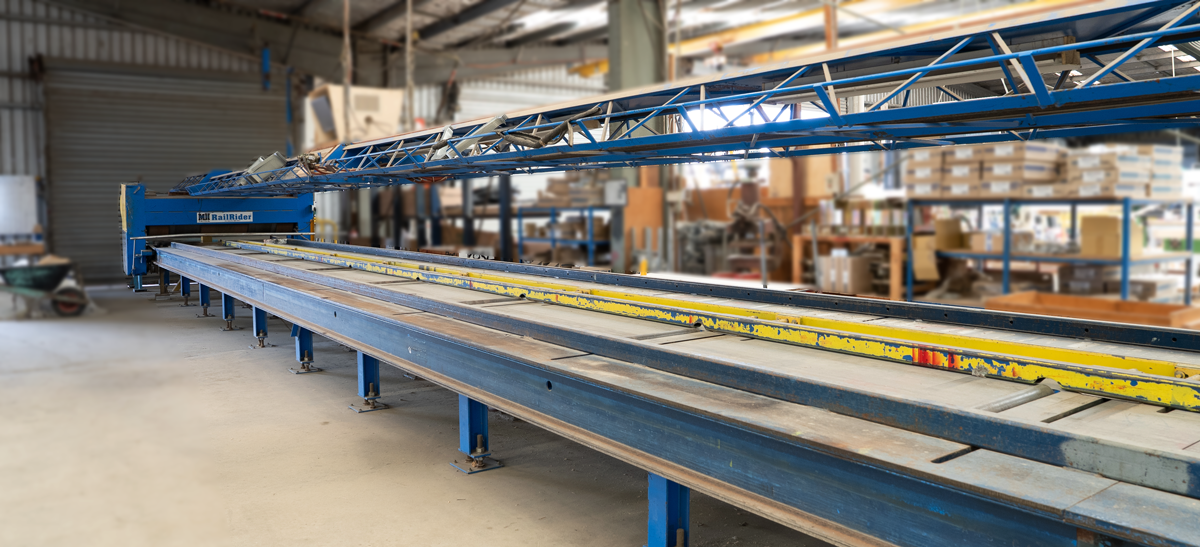
In frame and truss manufacturing today, very few plants are starting from zero. Most already have some level of automation—presses, saws, gantries, or software-driven design workflows. The real question is no longer “Should we automate?” but “Is what we have still working together—and still working hard enough?”
Because the hidden risk is not a lack of automation. It is fragmented automation.
Older machinery running alongside newer systems. Software that does not fully integrate with the factory floor. Processes that still rely on manual workarounds between “automated” steps.
That is where stagnation quietly sets in.
The real cost is not absence of automation—it is misalignment
Many manufacturers have invested over time, building capability piece by piece. But without ongoing optimisation, those investments can start to drift out of sync:
- Machines operate efficiently in isolation, but not as a system
- Data is not fully connected from design to production
- Bottlenecks shift rather than disappear
- Older equipment becomes the limiting factor in a modern workflow
- Staff compensate for gaps with manual intervention
The result is a factory that looks automated on paper—but behaves partially manual in practice.
And that gap is where capacity, margin and consistency are lost.
What are you actually missing out on?
When legacy systems are left in place without integration or upgrade pathways, the impact is less visible but very real:
- Lost throughput due to mismatched cycle times between machines
- Underutilised automation assets that cannot reach full capability
- Increased labour dependency to bridge system gaps
- Data blind spots that limit scheduling and forecasting accuracy
- Inconsistent output quality caused by manual handoffs between stages
- Reduced agility when shifting between product types or demand cycles
Over time, these inefficiencies become “normalised”—absorbed into everyday production expectations.
But they are not fixed constraints. They are upgrade opportunities.
How do you quantify the gap?
The challenge with partial automation is that inefficiency hides inside productivity.
To understand the real opportunity, manufacturers need to look beyond output alone:
- System throughput vs individual machine capacity
- Idle time caused by upstream/downstream mismatches
- Manual touchpoints between automated stages
- Changeover delays between product types
- Maintenance and downtime patterns in legacy equipment
- Labour hours spent coordinating rather than producing
When viewed holistically, the question becomes less about machine performance—and more about workflow performance.
That is where the real ROI of modernisation sits.
Optimisation is not replacement—it is integration
Modernisation does not always mean ripping out what exists. In fact, the most effective strategies often start with:
- Upgrading older machines to align with current throughput
- Integrating design software with production systems
- Eliminating manual transfer points between stages
- Balancing production flow across the entire factory, not just individual assets
- Standardising data from quoting through to fabrication
This is where optimisation becomes powerful: it turns a collection of machines into a connected production system.
A plant does not need more automation. It needs better-connected automation.
Balancing supply, demand and opportunity
When systems are integrated, manufacturers gain something far more valuable than speed—they gain control.
- Demand spikes can be absorbed without breaking flow
- Production schedules become more accurate and less reactive
- Labour is allocated to value-added tasks rather than coordination gaps
- Capacity becomes visible and usable, not theoretical
- New product opportunities become viable without re-engineering the entire plant
This is where optimisation moves from operational improvement to strategic advantage.
Because the goal is not just to produce faster—it is to produce smarter under changing conditions.
Automation in Action: Scaling Smarter with MiTek
At Inotek Timber Systems, Managing Director Ian Ashby highlights that automation only delivers its full value when it is part of a connected system, not a set of standalone assets.
After investing in a fully integrated MiTek automation suite—including the Ranger, Blade Saw, FlowMax and Roof Tracker—Inotek moved beyond incremental improvement to full workflow transformation.
The result was not only a doubling of roof truss production capacity, but a shift in how the factory operates end-to-end.
Ian notes:
“From installation through to onboarding, MiTek’s technicians were meticulous. They trained our staff so that we could use the equipment to its full potential.”
But importantly, the focus is no longer just on machines—it is on expanding the system itself:
“Now we are focused on what is next—automating wall frames, adding cladding, insulation and windows offsite, and introducing floor cassettes using the Posi-Strut system.”
That progression only becomes possible when existing automation is integrated into a scalable workflow, not left as isolated assets.
Updating without disruption: CapeView’s retrofit approach
At CapeView Building Products, part of the Coldon Homes group, General Manager Peter Sheerin demonstrates another critical dimension of modernisation: upgrading legacy systems without halting production.
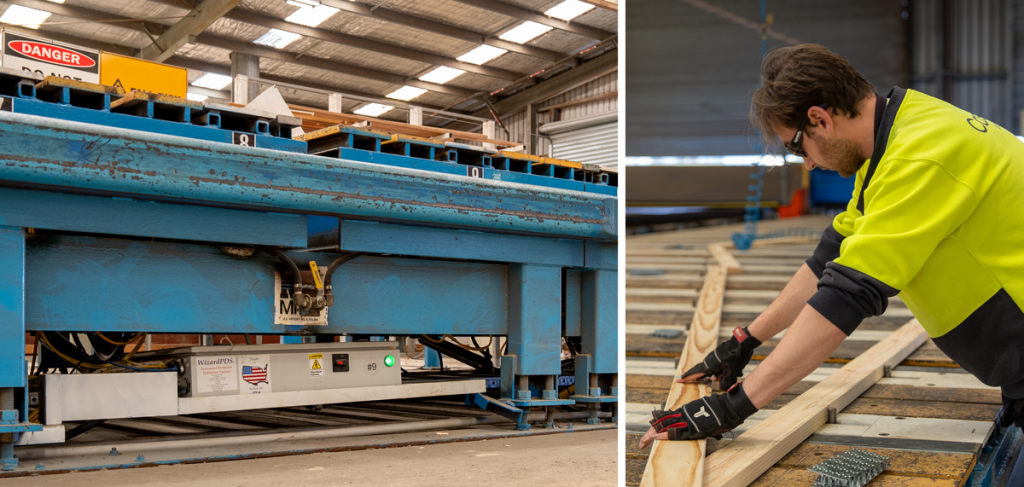
CapeView’s adoption of MiTek’s Wizard PDS focused on enhancing capability within existing infrastructure rather than replacing it.
Peter explains:
“The ability to retrofit the Wizard PDS into our existing tables was a major factor. It meant we could upgrade without stopping production, which was crucial for maintaining our output.”
This is a key reality for many mature plants—automation is already present, but optimisation comes from upgrading what already exists and ensuring it works as part of a unified system.
Integration with MiTek’s Optiflow software further strengthened this alignment between design and production, reducing variability and improving consistency across the factory floor.
How MiTek enables connected optimisation
As Director of Automation Solutions APAC Steven Callewaert explains, the focus is not simply on delivering automation, but on enabling scalable improvement across different levels of maturity:
“We aim to offer solutions that range from low-cost options that enable informed decision-making, through to high-end automation that delivers significant reductions in cost, increased throughput and reduced reliance on skilled labour.”
He adds:
“Our automation solutions enable customers to produce with more speed, higher quality and less waste, unlocking value across the entire supply chain.”
Importantly, this includes improving how existing systems work together—not just introducing new ones.
The real cost of standing still
In frame and truss manufacturing, standing still is rarely about doing nothing.
More often, it is about:
- Keeping older machines in service beyond optimal efficiency
- Running disconnected systems because they still “work”
- Accepting manual processes between automated stages
- Delaying integration because production cannot stop
But over time, these decisions compound into structural inefficiency.
The businesses pulling ahead are not always those with the newest factories. They are the ones continuously asking a harder question:
Is our entire system still working as one?
Because automation alone is not the advantage anymore.
Integrated, optimised automation is.