For Frame & Truss Manufacturers, Posi-Strut can be a valuable add-on to a truss manufacturing operation, providing a practical way to expand product offerings and deliver additional value to customers.
But, like any manufacturing process, getting the most from Posi-Strut is not simply about producing the finished product. It is also about how efficiently materials are planned, consumed and managed through production.
One challenge we heard from customers was the accumulation of unused ½ Posi-Strut webs.
While individual web components may seem relatively small, over multiple jobs the impact can add up – creating additional material handling, stock management and, ultimately, waste.
The underlying issue was linked to the way Posi-Strut designs were being generated. A bias in the design process could result in an imbalance between left-hand and right-hand webs, leaving excess ½ webs that could be difficult to use efficiently.
From visibility to optimisation
Rather than treating this as a single software issue, MiTek has taken a progressive approach to improving how Posi-Strut web consumption is managed in Sapphire.
The enhancements began in Sapphire 26.2, with a focus on giving users greater visibility.
Users can now see individual left-hand and right-hand Posi-Strut web counts, making it easier to understand what a job requires and identify potential imbalances before they become a production issue.
As Andre Barac from Oxley Frame & Truss explains:
“The individual Posi web counts in Sapphire v26.2 has already delivered significant time savings by removing the need to manually count webs on each truss. With the move to v26.3, the new Job Lot functionality will further improve efficiency by helping us optimise web stock usage and manage job quantities more effectively.”
That foundation of visibility has now been taken a step further in Sapphire 26.3.
Sapphire 26.3: Optimising web usage across the job
Sapphire 26.3 introduces new optimisation capabilities designed to help reduce the accumulation of excess left-hand or right-hand Posi-Strut webs in production.
The objective is straightforward: better balance the consumption of left and right Posi-Strut webs across a job, while maintaining the existing design and production workflow.
The optimisation can work by reversing the front/back web orientation on individual trusses or, where appropriate, groups of identical trusses.
This effectively flips the left and right consumption without changing the underlying web pattern.
For manufacturers, this means Sapphire can make better use of available Posi-Strut web stock without requiring changes to the fundamental truss design.
Greater visibility at job level
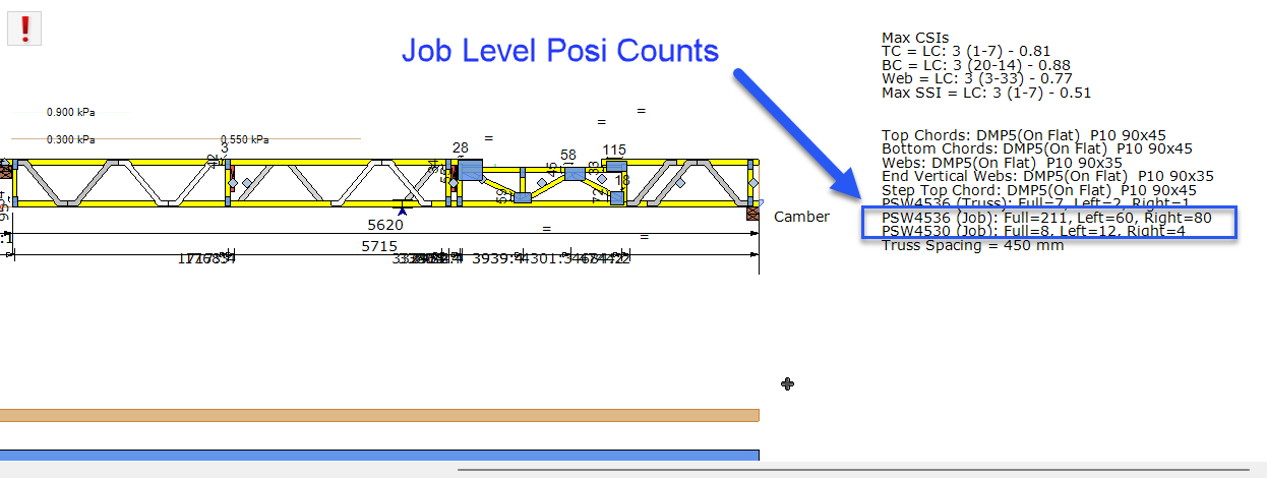
Sapphire 26.3 also brings job-level Posi-Strut totals into the workflow, giving users a clearer view of overall requirements.
This makes it easier to understand the quantity of each web type required across a job and provides information that can be used for production planning and stock management.
For manufacturers producing multiple trusses and jobs, this broader view can help shift Posi-Strut web management from a manual task to a more informed part of the production process.
Making better use of full webs
Another improvement in 26.3 is the web generation logic, which gives greater preference to using full Posi-Strut webs rather than paired ½ webs where appropriate.
The benefit is not simply a reduction in material waste.
Using more full webs can also reduce the handling associated with managing multiple smaller components, helping streamline production and potentially reduce the labour involved in preparing and handling Posi-Strut webs.
Importantly, the behaviour can be controlled by the user, providing flexibility to apply the functionality where it makes sense for their individual production environment.
More control over Posi-Strut placement
Sapphire 26.3 also provides greater control over Posi-Strut web placement.
Users can choose to reverse web placement on the front or back face of a truss, providing another way to help balance Posi-Strut consumption across jobs.
For F-Frames, a new web placement option has also been introduced to support better utilisation of left-hand and right-hand Posi-Strut webs.
These may appear to be small changes individually, but together they address a practical manufacturing challenge: how to get more value from the Posi-Strut material already being purchased and processed.
From material consumption to manufacturing efficiency
The evolution of Posi-Strut functionality in Sapphire reflects an important principle in manufacturing software.
Efficiency is not always about making a major change to the production process. Sometimes it comes from understanding the small inefficiencies that occur repeatedly and giving manufacturers better tools to manage them.
With 26.2, users gained greater visibility of Posi-Strut consumption.
With 26.3, that visibility has been extended into optimisation, helping manufacturers better balance web usage, reduce excess material and improve control over job-level requirements.
The result is a more informed approach to Posi-Strut production – helping manufacturers make better use of their materials, reduce unnecessary handling and support a more efficient manufacturing process.
Most importantly, these improvements have been shaped by feedback from the manufacturers using Sapphire every day.
Sapphire 26.3 brings that feedback into the software, turning a real-world production challenge into a practical opportunity for greater efficiency.